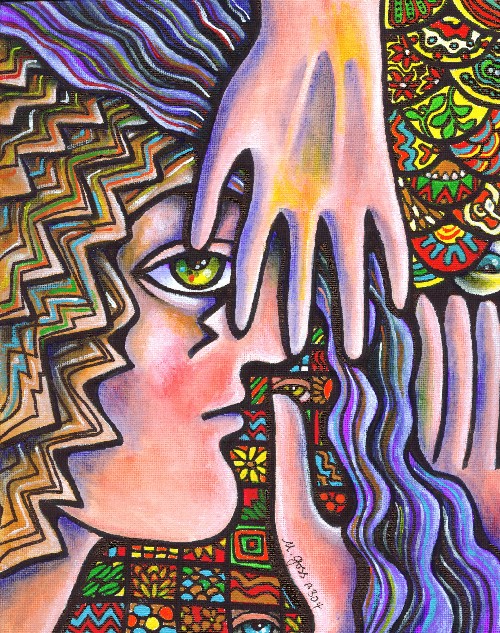
20 January, 2004

342 Marc & Jed


342 Marc & Jed
24x18" acrylic on board
commission

19 January, 2004

A341 Wedding


A341 Wedding (for Heidi & Nathan)
24x18" oil on canvas
private collection

Anomaly Series

18 January, 2004

A340 Memory one (Flux)


A340 Memory (flux)
36x24" oil on canvas
$800.00

This painting is about how flow (inspiration) works, in and out. A cacophony of information and ideas enters the woman’s head, and a single rivulet of pure vision enters her eye, and pours out. The conversion from chaos to clear flow is the artist’s refining process, thinking and working.
The persistence of all those garbage memories we tend to store away, threatens to overwhelm us. You can see that this lady has managed to refine them into a crystal stream pouring steadily from her eyes.

As I worked my way around the figure, I was thinking about the bottom right corner, which is a geometric pattern, as opposed to the organic shapes of the rest of the painting. I added a very anomalous set of green pyramid forms in the lower right, very strange and somehow wonderful.

Anomaly Series

17 January, 2004

339 Kapuskasing River


339 Kapuskasing River
20x24" acrylic on canvas
commission

16 January, 2004

338 Kapuskasing River


338 Kapuskasing River
20x24" acrylic on canvas
commission

15 January, 2004

A337 Artist & Anomaly IV


A337 Artist & Anomaly IV
10x8" acrylic on glass
private collection

A pointillist study of an artist friend, France. I wanted to capture the joy and concentration of the artist at work.

Anomaly Series

14 January, 2004

A336 Memory Work


A336 Memory Work
20x24" acrylic on canvas
Private collection

Anomaly Series

13 January, 2004

A335 History II


A335 History II
16x20" mixed medium on panel
private collection

Another version of the clutter we carry around with us. Our own personal history, all the things we have said and done, swirls around us, sometimes coming into focus, but mostly remaining peripheral until something reminds us. Our history, like Memory, forms a life pattern for each of us, the positive and negative elements changing according to our experience and mood. Kaleidoscope and cacophony, an adornment and a burden; some people cling to their history, while others try to shed it, and don another.

Anomaly Series

09 January, 2004

A326 Reformation V


A326 Reformation V
10x8" oil on glass
Private collection

A pointillist 'reformed' segment of A298, Artist & Anomaly.

Anomaly Series

06 January, 2004

A323 Reformation II


A323 Reformation II
11x14" oil on canvas
private collection

This is an 'alla prima' study of some free-form shapes I made with oil and a large brush. The pointillist details suggest the developmental, biologic forms I am interested in, and are also reminiscent of the Paleozoic fossils in the previous series.

Anomaly Series

04 January, 2004

A321 Artist & Anomaly III


A321 Artist & Anomaly III
10x8" acrylic on glass
private collection

A self-portrait.

Anomaly Series

03 January, 2004

A320 Anomalous Piercings


A320 Anomalous Piercings
20x24" oil on canvas
$550.00

My idea was to show the piercing quality of pain and light, as a riving, but also as inspiration, the bolt that awakens you from inertia and complaisance. As well, lately I have been using the idea of the split person, but only to show how much can be going on at one time, in one mind, and the duality of our nature.

Anomaly Series

01 January, 2004

A318 Sum VII


A318 Sum VII
10x8" acrylic on glass
private collection

The figure juggles several patterns she has formed, while immersed and surrounded by sequences of other patterns. The loose, perception pattern (symbolized by eyes and neurons) of her clothing, the pattern she choses to wear, contrasts with the symmetry of the background patterns. The figure doesn't 'fit in', and certainly the patterned masses she juggles do not blend in. She may be trying to make them fit somehow, or she may be keeping them separate.

Often our ideas, even our ideals, do not fit into the regular pattern of our lives, but we keep them delicately balanced, out there in front of our eyes, to remind us of what we strive to be. If we cling to one idea too long, the others must fall by the way. With concentration, however, we can keep various ideas going, sometimes for a lifetime.

Anomaly Series

29 January, 2003

A317 Sum VI


A317 Sum VI
6x4" oil on board
private collection

The figure has his face turned to the wave patterns, which seem about to penetrate his face. Enough to make his eyes water.

Anomaly Series

28 January, 2003

A316 Sum IV


A316 Sum IV
6x6" acrylic on board
private collection

The figure is surrounded by energy patterns, and turns her face up to 'drink in' the resulting inspiration. It flows through her eyes and her mouth, images and words.

Anomaly Series

27 January, 2003

A315 Sum III


A315 Sum III
10x8" acrylic on canvas
private collection

The figure points to herself, acknowledging her personal reality. Ideas, like iterations of herself, shadow her, waiting to be incorporated (a good word in this sense) or abandoned. What interests me is that we carry ideas around with us, or they attach themselves to us, but we seem to avoid or even try to escape them. It is true that an idea must be embraced or absorbed before it can truly said to be part of our identity. And that identity is the summing up of a lifetime's worth of concepts.

Anomaly Series

26 January, 2003

A314 Sum


A314 Sum
10x8" acrylic on canvas
$65.00 (framed)

A quaint figure in a strange landscape. Ego sum...this room reaching into the outdoors. Most of my paintings twist things inside out and vice versa, or can be seen both ways. Existence, inner and outer.

Anomaly Series

25 January, 2003

A313 Sum II


A313 Sum II
7x5" acrylic on canvas
private collection

I was thinking of the word sum, which means a summing up, but also is Latin for 'I am'. The figure is both supported and partly hidden or submerged by history in the form of a fossil. But the figured is also 'enlightened' by the glowing possibilities of ideas, above.

Anomaly Series

24 January, 2003

A312 Reach VI


A312 Reach VI
7x5" acrylic on canvas
private collection

I was trying to capture the feeling of reaching as far as you can for an idea (reach for the moon), and the heightened senses that mark a state of inspiration. Hence the electrified hair.

Anomaly Series

23 January, 2003

A311 Reach V


A311 Reach V
7x5" acrylic on canvas
private collection

The physical gesture of reaching, of course, draws the two figures together. Their faces almost merge. They are 'eye to eye', connecting.

Anomaly Series

22 January, 2003

A310 Perceive III


A310 Perceive III
5x7" acrylic on canvas
private collection

A simple idea, perception through a sort of mist. But is the idea flowing in or out? And is the idea distorted slightly by the (a priori) fossil shape of personal history?

Anomaly Series

21 January, 2003

A309 Reach IV


A309 Reach IV
6x6" acrylic on canvas
$35.00 (framed)

One figure reaches through 'flow'. I had the idea of feeling your way through ideas, but also of groping around for ways to express them, to share them with someone else. For another person to understand your ideas, you have to pull them into your stream of thought.


Anomaly Series

20 January, 2003

A308 Perceive II


A308 Perceive II
10x8" acrylic on canvas
private collection

Here the figure is reaching out, perceiving even through a dense veil of distraction. The ideas crystallize, dropping steadily.

Anomaly Series

19 January, 2003

A307 Perceive


A307 Perceive
10x8" acrylic on canvas
private collection

Here the figure ponders over her own history, coiled next to her heart, and influencing everything she perceives. Every perception is lined up literally staring at her, eyes strung like a row of beads on an abacus.

Anomaly Series

18 January, 2003

A306 Reach III


A306 Reach III
10x8" acrylic on canvas
private collection

A further exploration of the 'reach' concept. The figure is compelled...her hair is standing up, and the atmosphere is full of energy, lightening bolt patterns. But she has not 'grasped' the idea. A blanket of domestic patterning holds her down. I like the line of hesitation in this one, between the proffered hand and the figure.

Anomaly Series

17 January, 2003

A305 Reach II


A305 Reach II
10x8" acrylic on canvas
private collection

This image, also based on the idea of 'reach', depicts acceptance, of both the reaching-out of another (the hands, obviously not belonging to the figure), and the tears or drops, another way of depicting flow. Flow, if it is to flow freely, must be allowed to run its course, and this includes all ideas, however inappropriate and useless they may seem at the time. The figure accepts the idea (reach) and allows them to emerge unimpeded. This 'emptying' method, provides rich material for creation.

Anomaly Series

16 January, 2003

A304 Reach


A304 Reach
10x8" acrylic on canvas
private collection

I finished A304, and was pleased with it, though wondering whether the hand that is reaching down should have been differentiated more from the other. But I left it the same, since the ambiguity is also appealing; are both hands hers, or is one hand someone else's.

I have been trying to depict how ideas, which almost always appear as anomalies in the fabric of our day, must be reached for. An idea will touch you momentarily, but unless you literally grasp it, the idea vanishes in the complex patterns we surround ourselves with. The watery pattern represents flow, the state of creativity and receptivity.

Anomaly Series

15 January, 2003

P303 History


P303 History
14x11" acrylic on canvas
private collection

This little picture has for its theme history, the idea that we sometimes hold onto our history...here the woman is almost clutching it to her breast.

Paleozoic Series

14 January, 2003

A302 Entropic Woman


A302 Entropic Woman
36x24" oil on canvas
private collection

The patterns on her (Entropic woman) are all writing with a brush, upside down and backwards, etc. A sort of impromptu poem, but it would be very difficult for anyone to decipher. It's not important that you can read it, just that it's there, as all poetry is, except most people don't pause to notice it.

I was intrigued with the idea of entropy, of slow decay. So in the painting, the woman is losing information, bits of herself, data, behind her...but she is also building or adding information in front. She is pushing ahead, always pushing and gathering more information to make up for the loss. An important balance...instead of trying to hold on to old stuff, make new stuff.

In the same sense, ideas flow into us, and flow out of us in the form of our writing and painting. The in-flow is just as important as what comes out, for we are assimilators, translators of what we perceive.

I deliberately made an innocent, amorphous shaped woman; she is clean and glowing, open to new ideas, pushing ahead.

Anomaly Series

13 January, 2003

A301 Dichotomy II


A301 Dichotomy II
20x24" oil on panel
$550.00

At first, beginning to work on the face of the background figure, and continuing the eye' pattern on the arm, I thought it was impossibly ugly. But as usual the combination of soft modelling and colourful patterns are beginning to work together to make an intriguing picture.

I finally settled down to work on a sketch in my sketchbook, and completed a fast under-painting in bright red and yellow, a visage with more zig-zags like lightening bolts. This seemed to warm me up, as I quite enjoyed myself, and I moved over to the table to work on A301 again, completing most of the pattern outlines in black. For this painting, I again tried to contrast the two characters, using geometric angular shapes for the background figure, and floral natural shapes for the front figure. It is hard to tell if the back figure is clutching the front one, or if the front figure is clutching herself, in a sort of protective gesture. It is the ambiguity of the gestures that interests me, because it is how life is. We are never quite sure what we are seeing, how we interpret things. I certainly feel that these chaotic patterns and colours represent our real life, almost overwhelming input of detail all the time, which our brains do an admirable job of filtering, and then the other layer of chaos, the accumulating burden of detail...ideas, events, images and just the things we pick up along the long way of our lives, a great many of them unresolved or perplexing to us, so that we tend in our idle moments to pick through it all, turning things over and over and wondering at them or grieving over them. We move forward, but are continuously glancing back, hence the horrific split; it's a wonder we don't have two heads.

A301 suddenly takes on great significance for me, as the myriad eyes on one character's robe squint and weep, the other character's eye as staring and empty. The clashing patterns are the too-bright world I cringe from, the world that makes my eyes water. The Christmas-coloured flowers of the other robe are my sanctuary. But I have yet to scribble on this painting.

... adding silver lines and another layer of background detail as well as patterns on the arm on the left. This arm is interesting, because it is difficult to make out whether it is the arm of the back figure or the one in the foreground, on the left. One is inclined to associate it with the foreground figure, so I added some of the background pattern to add to the ambiguity. My idea was always that the two figures are really the same person, the dichotomy of being.

It is a strange picture, because of the three arms. With a little imagination, you can attribute all three arms to either figure. I added to this illusion by giving the arms different patterns, not immediately identifiable with either character.

Anomaly Series

12 January, 2003

A300 Artist & Anomaly II


A300 Artist & Anomaly II
24x18" oil pastels, oil, pencils on paper
Private collection

One of the students working at a paint-a-thon at the mall to raise funds for their art class, was gleefully attacking a huge sheet of paper with a big brush and bright colours. There was a wonderful atmosphere of discovery and camaraderie among the artists, young and old. While she and I talked, I made a quick sketch of her at work, and finished it later in the mall studio.

Anomaly Series

11 January, 2003

P299 Dichotomy


P299 Dichotomy
14x10" oil on canvas
private collection

July 20, 2003: I sat in the living room, at the library table and drew a new small canvas, P299, Dichotomy, a continuation of the idea in P297, of deliberate thinking, or structured thinking, and using both sides of an idea, or an argument.

July 29, 2003: When I got home, I finished P299, Dichotomy. What a strange picture it is, the womans face divided by different eyes, different vectors.

Paleozoic Series

10 January, 2003

A298 Artist & Anomaly


A298 Artist & Anomaly
24x18" oil on linen
private collection

In the studio, I worked on A298, Artist and Anomaly. Josée had posed for this at last year's festival, and I had done nothing with it. Now the pose, folded up in a zigzag, and bold figure seems to suit the Anomaly series, above all the expression on her face. Today, with mother colour of Paynes grey and Prussian blue, I drew designs above the thunderbolts I sketched in the other day with pencil, and the bolts themselves I tried in silver oil paint.

When I had worked as much as possible on A301, I turned to A298, Artist and Anomaly, which Josée posed for and has been abandoned for some time. I mainly added black brush patterns, but also had a chance to begin one of the scales, which cover part of her body, using the turquoise oil paint I have favoured lately.

February 13, 2003: I put one of the Gulag Archipelago CD's in the computer, and listened to the droning account of prison life in Russia while squeezing out oil paint. I already have several pictures started; I was able to sit down to A298, Artist and Anomaly, without thinking, and continue the green scale patterns on the character's legs. I worked away, quite happy for an hour or so, and was very pleased with the results.

There are still some details to be done. I have ideas of using a pointed brush to draw all over it, and maybe I will do just that.

February 18, 2004: After breakfast and reading, I went straight upstairs to the studio and, putting on one of the Gulag discs, listened to endless tales of prison life in Stalinist Russia while working on A298. Without hesitation, I began drawing with a pointed brush and black oil on top of the painting, making it what I have been thinking of lately, rather than simply finishing the painting the way it had started. In fact, I can't really remember what my intent was in this picture. It was one of those in-between paintings, the iteration of an idea already established, as often happens in my series. I did not look at the results of my scribbling on top of my painting, just did it, and an hour and a half later, setting the painting right-side up to have a look, I was satisfied, and more importantly, truly engaged once more in this painting.

Anomaly Series

09 January, 2003

P297 Fossil Brain


P297 Fossil Brain
12x9" oil on cloth mounted on panel
Private collection

June 22, 2003: While cleaning up in the studio, I found an small unfinished Paleozoic series sketch on cloth mounted on a board, and decided to finish it. The painting has the number and title P297, Fossil Brain. It is really just a visage with some cephalopod growths, one of those small simple pictures with a single message. The small works, if they are to have large enough characters and objects to be strong, can only have a single idea, sometimes only a single image. I always feel as if they should be strung together, like a necklace or patchwork, to show the path of my ideas.

June 25, 2003: After supper, I worked on P297, finishing the face. It is a curious combination of Venetian red, turquoise and flesh, with touches of yellow-green. My thoughts curl at a snails pace, and my creature smiles painfully.

Paleozoic Series

A295 Existential Knot Anomaly


A295 Existential Knot Anomaly
30x40" oil on canvas

06 January, 2003

A294 Peripheral Revision


A294 Peripheral Revision
24x18" oil on canvas
Private collection

May 10, 2003: I slipped away to work on the sketch under-painting for the new canvas, A294. After a conversation with Linda about the burdens we carry around and the things from our past that keep pecking at us, I wanted a character sort of wrestling with a raven, the burden of ideas or philosophies that refuse to leave us alone. So back to Paynes grey, flesh and a new turquoise, with Alizarin crimson for the red, I think.

May 16, 2003: A slow but productive day. Still feeling sluggish and swollen. I cleaned the studio and the office, and made a great deal of progress on A294, Peripheral Revision. At first I did not like the heavy texture of the linen canvas, but before long I was enjoying the way the brush scrubs on it, and the paint gathers in the pits and ridges. The face of the creature is passive, veins and eyes bulging as she tries to catch a raven...or is she batting him away?

June 17, 2003: After a light lunch, I worked in the studio for a couple of hours, on A294. Everything is falling into place now, the feathers filling in nicely, and the pattern on the characters shirt.

After resting for a while, I worked again on A294, finishing up the feathers and painting in the modelling on the right side arm. This painting is going very quickly now. I am enjoying the heavy texture of the linen canvas, finding that dry brush techniques and glazing work wonderfully. It is a different feel, certainly. And my graphic lines look different.

On this painting, I am also trying a new colour, turquoise. Of course, flesh combined with Pthalo blue also makes turquoise, so there is a nice blending of tones there. The Alizarin-patterned fabric, floating above the skin of the character and drifting over the edges of the canvas, adds delicacy and beauty to an otherwise slightly disturbing image, the dark feathers, the odd way the character is intermixed with the bird, and the weary expression and attitude of the character.

What is happening here? The character writes or draws, allowing the raven to pass through her. She accepts the dark flutter, embraces it, her gaze focused on the pure white of the paper. The teacup emerges from a spin of turquoise that flows into or out of a cephalopod.

Anomaly Series

05 January, 2003

A293 Anomalous Picnic


A293 Anomalous Picnic
24x36" oil on canvas
private collection

March 2, 2003: I drew a woman on the new large canvas, stretched out at a picnic of strange objects, A293, Anomalous Picnic. She looks bemused, as if playing a game of chess. This is a more innocent- looking picture, and much flatter than the others in the series. I had thought to do it with no shading, but I suppose that will depend on how I feel as I do it. Tonight I painted some French Ultramarine into the background, like a sky, or perhaps a river. There is supposed to be a cloth on the ground, and the dishes will be full of incongruities. Chaotic tidbits.

March 5, 2003: I have been enjoying using cadmium red in this painting, mixing glowing flesh tones using it and cadmium yellow. The womans face is full of lines, but serene; she has earned her picnic.

March 19, 2003: Upstairs in the studio, I worked on A293, little fossil cookies and a delicate cup with a design of blue and white synapses. I have been thinking of these paintings as representative of the chaos of our lives, so many patterns and choices, so much happening. But also, in spite of all that we notice, our perception of the world must be somewhat flat and graphic, as we tend to generalize and idealize everything, not looking closely or investigating, or perhaps not wanting to, frightened by the complexity of it. Any anomaly is too disturbing ...I worked on my painting a bit more, drawing amphibian fetal patterns on a large green plate. They look like carved beads.

March 25, 2003: I spend some time in the studio, and finish the first layer of shading and outlining on A293. I plan my patterns carefully, gourds bursting with motifs, the warped web of the cloth, the glowing orange of the arm of the woman. She is dining on the bits of matter that life gives her, converting it all into her own design.

April 30, 2003: I took my second cup of coffee upstairs and put Wagners Ring Cycle on the stereo. I sat down at the studio typewriter and studied yesterday's single line of poetry, catching a bit of flow. For about an hour, I typed and re-typed lines, eventually coming up with two more stanzas, inspired by my painting session last night. I spent the rest of the morning working on A293, which is beginning to shape to my original ideas. The central green plate, set up on its edge at odds with the false perspective of the checked cloth, is a trompe loeil of flat and dimensional patterns, inspired by amphibious egg development. It blooms like an Aztec calendar of biologic glyphs. Its persistent growth precludes any preoccupations with the other picnic choices; pabulum and pills, generic fossil feed. Staring into such a plate as the green one, we feel we must go on, be something else. All else is shells, inertia and weeping over teacups.

Anomaly Series

04 January, 2003

P292 Artist & Orange Chair with Fossils


P292 Artist & Orange Chair with Fossils
24x30" oil on panel
$800.00

My friend, collaborator and fellow artist desean posed for this picture some time ago, and it has gone through several iterations of itself, as well as crossing several series.

It began as an Orange Chair painting, and the under-painting and content were in that style. It was put aside, however, for some reason, possibly because it did not properly evoke the atmosphere of my discussions with Dennis.

When I next pulled it out, I was deep into the Paleozoic Series, and added more fossils to it, and the colour scheme of the series. Again, it was put aside. When the Orange Chair reappeared in some of the Paleozoic and Anomaly paintings, I brought it out again. This time, I added the patterns of the Anomaly Series and finished the painting.

Although it would sit comfortably in the Anomaly Series, I left it in the Paleozoic era, a tribute to enduring ideas that are dug up ages later, to be studied from a different angle.

Paleozoic Series

03 January, 2003

A291 Anomalous Print


A291 Anomalous Print
24x18" designer's opaque gouache on paper
Private collection

July 2002: I made this sketch of Josée, an artist friend, as she worked on a lino-cut print at the Moonbeam Arts Festival, and painted and drew on it all week while we sat at the exhibit. Josee also uses checkerboards or mosaic squares in her work, often in the form of a quilt. We are both interested in the idea of our life experience being a 'pieced-together' mosaic of patterns, some matching, some anomalies, some holes. In the background of this picture are a couple of Normand's paintings, covered over with my patterns, my perceptions.

Anomaly Series

02 January, 2003

A290 Agony & Anomaly


A290 Agony & Anomaly
24x18" watercolour on paper
$250.00 (unframed)

This sketch was made at the studio in town. The lightening bolt motif refers both to inspiration and division, the character undecided, or equally pulled in two directions. Thus decisions in life can be necessary, but painful. For some time I have been interested in the divided mind, the dichotomies of living. It is much the same concept as the mask; life is not obvious, or what it appears. Nor is it black and white...the line between dark and light is often complex and puzzling.

Anomaly Series

01 January, 2003

A289 Anomalous Inclinations


A289 Anomalous Inclinations
20x24" oil on canvas
private collection

January 1, 2003: I draw him (Ted) reclining, looking slightly up at his chin, which shows off the classic angles of his face, and deep cleft of his chin. Ted and I had an interesting conversation the other night, about alternate universes and pathways, and I want to get some of this in the picture. I will have bands of light and pattern streaming around and through him.

January 10, 2003: I started the painting of Ted, using various combinations of Alizarin crimson, raw sienna and ochre. It is shaping up nicely, though I think I may not use the outlining of the last two paintings, rather painting the patterns in and outlining with a brush where necessary.

January 13, 2003: ...went upstairs to the studio to work on A289, and listen to The Flying Dutchman. On a whim, after painting Ted's shirt ultramarine, I drew little people with black oil, what I imagine to be events or dreams in his life. Tomorrow I will fill them in with colour, like cartoons. I also began outlining some of the patterns I had made in the background.

January 14, 2003: I had my coffee and read for a while, then got dressed and made for the studio. With more Wagner on the CD player, I worked steadily on A289, filling in patterns with colour on the shirt, and drawing more outlines. The entire painting is taking shape now. Using the traverse stick, I am making larger pattern shapes and filling them in with colour. I will paint one layer of rough patterning over the entire painting this way, then decide which areas need more detail, instead of completing all the detail in each section as I go along. As well, I am waiting to see how much outlining I want in the face.

January 19, 2003: Back at work on A289. The patterns on the shirt now seem to merge with the background patterns, but I will complete the first layer before deciding what to do. Some heavy outlines will help, and if I confine the copper to the background, it will also help redefine the areas. I will also use the copper in the background to make other patterns, so the background will have lighter details. What a patchwork our lives are, of repeating motifs and variations. What a conglomerate our lives become, of patterns we can't escape or forget, the fossil remains of bits of our lives, merging with other bits, forming our being and our burden. The background in this painting humps forward, over the shoulders of the character, who stares out of his patchwork, all the pieces of his present, into another place. His thoughts are projected out of a mass of incongruities. It seems impossible that he should be ignoring all that colour and design, but there is no doubt his mind is elsewhere.

I have always been fascinated by the mind's ability to ignore the chaos surrounding us, or to pick out a single idea out of it all. Our brains can single out a colour, a shape, a sound, or a smell in the cacophony around us, isolating it for contemplation. Or our brains, after observing an endless array of patterns and shapes, can invent a new one. We thrive on chaos. We desire complexity. We seek the thing that is different, even while we stop to admire the thing that matches or complements what we have already experienced.

And then there is our brain-talent for splicing things together, taking disparate elements, patterns we recognize or shapes that divert us, ideas that come to us, and recombining them, or simply concatenating them into new mosaics. The mind can play at this forever. The more sciences and fields of knowledge we add, the more personal experience, the more varied and complex the mosaic becomes. Ideas weave together, separating some concepts, bringing others closer together, and the tapestry continues to expand, ever rich, ever changing. It streams before our mind's eye, never quite repeating, often familiar, more often strange and disturbing.

In spite of all this chaos, we live, each of us encased in our own universe of memory and experience and information bits, and we interact with others, each also surrounded by their own chaotic universe. So much pattern, so much information noise, yet we function. In fact, if we were isolated from it all, we would starve for want of sensory and mental input. Severance from the kaleidoscope of our world would mean intellectual death, the greyness of dreams, fading afterimages and then blankness.

Strangely enough, that blankness is often sought, in certain meditative states, for example, and in writing and art, where one seeks to empty the mind of all the accumulated detritus of daily life, and find a truth, or an inspiration. If an artist doesn't do this, he keeps repeating himself. A series can quickly become iterations. Or stutters. An artist is always trying to trick himself out of his comfortable state of ritual and rewind.

January 23, 2003: A289 keeps changing, as I add more layers to the patterns. On this painting, I am working more to formula, each area having patterns detailed with its main colour, so the background patterns have copper details, and the shirt has blue details. It is a way of achieving separation without shading.

January 29, 2003: I worked for several hours on A289, which I had abandoned for a few days, letting it dry a bit before I added more patterns. The freehand brush drawing in black takes me to another place, as I add characters and events and whimsical ideas, all in black oil outline to be coloured later. The background, in stylized geometric patterns, is accented with copper oil paint, lending it a Byzantine or Moroccan air. So, the character has his life surrounding him, his background, parcelled and organized in a formal patchwork, his daily life, worn like an embroidered, fantastic shirt, and his thoughts streaming through and past him like beams or ticker tape.

January 31, 2003: I ...set to work on A289. I still wasn't happy with the separation of the character from the background, so took the bold step of placing a white line around the character, which I have been considering for several days. I had been using white to delineate various patterns in the blue shirt, also as a device for making the shirt stand out. The white outline had an immediate effect, and I continued it up into the character's hair. For a few moments, I was reminded of an Elvis impersonator in one of those embroidered costumes, or perhaps a Flamenco player. But that is life, over-embroidered, flamboyant and a bit gaudy. This character is literally wrapped up in it.

Then I spent an hour or so painting in more patterns on the shirt, a bird, golden scales, and fish leaping out of curly waves. The little motifs and characters within characters take me various places, each section a total immersion, either fanciful or vaguely familiar. I have a strong urge to continue off the canvas and onto the walls of the studio.

Anomaly Series

04 January, 2002

P287 Growth


P287 Growth
18x24" oil on canvas
$400.00

March 26, 2002: I moved on to the other oil, P287, and filled it with black outline patterns, after painting a face in the middle. It had occurred to me that it was very much like page one of my illustrated poem; the face looks like it is appearing out of heaps of blankets, or sedimentary deposits full of fossil remains and striations.

May 25, 2002: I worked on P287, growth anomaly, using a permanent marker to make some lines and dots, everything streaming in and out of the central visage.

January 10, 2003: I took down the even more annoying Growth, P287, and determined to finish it. There is certainly something compelling about it, and I need time to think about the new sketch that Ted posed for. I want vectors running around and through him, but don't know whether they should be patterned. And should I continue with the outlining? The bands running through the sketch lead me in many directions, as I intended. Perhaps they should have unexpected patterns or textures.

January 22, 2003: After breakfast and reading some history of the Incas, I cleaned up the kitchen, and went up to the studio. Leaving A289 to dry for the day, I picked up work again on A287, Growth, drawing and filling in patterns in various colours.

The face in this painting, actually a visage, is flat and graphic, a contrast to the realistic face in A289, but it has much the same feeling of thoughtfulness and meditation, of the myriad symbols and varying motifs of our thinking, and of the outside data that intrudes its own patterns. I always listen to music while I am painting and writing...Mahler and Wagner's Ring Cycle for most of this series...and the music definitely weaves itself into my work, just as what I write appears in my paintings, and what I paint become words in my journal. But there are other outside bits of information, some interesting or a pleasant surprise, such as the song of a bird outside the studio, or the cracking of ice in the lake. And other input that is intrusive, such as the phone ringing, someone distracting me with useless talk, or worse, someone at the door. While I am painting or writing, I am definitely anti-social.

But the best part, as my characters seem to verify, is making sense of all the motifs, fitting them together into your own, new pattern. We are all experts in recombinant theory, blithely stitching together the disparate elements of our daily lives to form a mad quilt, our carapace and our comfort.

I finished A287, surprising myself when I suddenly arrived at the group of patterns I had begun with. A sort of Möbius...I was quite comfortable with it flipped upside down, and disconcerted when I arrived back at the bottom.

Paleozoic Series

03 January, 2002

P286 Fossil Moves


P286 Fossil Moves
24x18" oil on canvas
private collection

October 6, 2002: I spent most of the morning working on P286. The patterns are developing rapidly; organic shapes for David, chequerboard for Jason. The flowing shapes of David in contrast to Jason's compartments, constantly changing patterns like a patchwork.

October 17, 2002: A few more patterns appear on my painting. The pattern on the figure Jason posed for, in P286, has a chequerboard of designs, like segmented armour or windows that lead elsewhere, true anomalies. And I have added little calligraphic tattoos. Windows and wards, tokens and amulets. Every new pattern takes on a different meaning.


Paleozoic Series

02 January, 2002

P285 Fossil Find


P285 Fossil Find
24x20" oil on canvas
private collection


Melanie posed for this figure at Christmas. The little curled-up "fossil" is baby Noah, born June 15. My idea was to show biological growth as the patterns on her robe, and the complexity of emerging life. I have been using more and more patterns in my work, working developmental elements into the designs.

March 6, 2002: P285, Fossil Find, the one of Mel, is deep reds, blues and oranges, with her robe in bright yellow and the little fossil in green. I will be able to use patterns extensively, I think, because of all the large plain areas. I am looking forward to experimenting with it.

...I positioned P285 on the easel and began to work up the hair with madder brown. Already I envision the patterns in this one, strongly surrounding, almost camouflaging, the foetus. In a way, the yellow central shape of my experimental abstract reflects the shape of the foetus in this painting. I imagine it as a node of some sort, a seed with venous outgrowths, or simply a burst of growth pattern. But of course to be a real abstract it must only be derived from the idea, not the image of these things, a mental pattern of only imagined workings.

March 26, 2002: By nine o'clock, after getting dressed and fetching another cup of coffee, I was painting in the studio, working first on P285, Fossil Find. I made the patterning in the hair, parallel lines of black, blue, white and red. Then I used black oil to draw two separate bands of pattern on the character's yellow robe; a band of spirals, striped with red and white and black, and a band of stylized lilies, filled with red. The painting is beginning to come alive, the patterns like codes or age rings on trees, or sedimentary layers, full of the patterns of a day.

March 27, 2002: Early morning is the best time, after my medication has taken effect and I am not so stiff and sore, after my reading. I stop here to write, or go straight upstairs to my office or the studio. But the studio is radiant in the morning, with its windows facing east over the lake, and nothing to see but water and sky and trees. The studio is spare and clean, with its various work areas, a writing table with old typewriter, a work table where P287 is laid out at the moment, to work on when I need to rest my arms, the big easel in the corner, with P285, the big tool chest on wheels full of painting gear, the bookshelf and comfortable camp chair, with my tapestry and books of poems for moments of rest, the antique postal desk with its slanted surface, for my sketchbooks and watercolours, and the stereo equipment for playing music old and new, book tapes on philosophy, and CD's of poetry readings. The sun slants across the studio in buttery streaks, warming everything.

I like the studio best when there are no paintings hanging on the walls, just white walls and the works in progress. Nothing distracting.

I set to work putting colour into the pattern I drew on P285, a loose design of fertilizing ovules, looking very much like flowers. I like the varying amoeba shapes, and I was very pleased with the fleshy orange outer petals'.

April 10, 2002: I woke up this morning to the sound of dozens of ravens calling to each other, then a large flock of song birds, their calls echoing and building in the trees. The sun was shining. Spring appears to be on the way. My fifty-second spring, in fact. The snow is still piled deep in the yard, but the deck is almost clear, and soon I will be able to sit out there with my books and coffee.

(In the studio) I cleaned off the palettes and put out fresh paint, and added some more layers to the pattern bands on P285, Fossil Find, which is really shaping up. I want to develop more complex patterns and layers in the series, especially patterns that represent what is going on in the picture, even patterns that tell a story, like hieroglyphics. For this I have been looking in my Anatomica and developmental biology, for growth sequences. The idea fits in well with the fossils, too.

April 19, 2002: I went straight to the studio and set to work on P285, which is nearing completion, so I like it again. As I was working on it, I thought of how the patterns could be used to tell their own story, or form a sequence, as these reproductive shapes do, but have the patterns evolving like cartoon strips, moebius animations. And more emphasis on layers and segmentation within the patterned areas. I want to retain some modelled areas, though, particularly faces and hands. Nothing new there, but something may come of it. The patterns feel right. Thinking of hieroglyphics and pictographs.

Doesn't this fit into the new society, the shorthand of our thinking processes, everything geared to the short attention span, thinking in cartoons, or thinking that everything fits into a category, a prefabricated box. All those advice books, how to think, how to act, how to fix your life, templates and guides for living. Patterns to follow. But what if the patterns take on a life of their own, begin to diversify? Evolution.

Paleozoic Series

01 January, 2002

P284 Curling Inward


P284 Curling Inward
24x18" oil on canvas
private collection


February 24, 2002: A good start on P284, Curling Inward, which has great dull orange billows curling out from the figure. I doggedly worked at it on and off all day, to complete the orange background, at least as far as I want to take it. I may add some patterning later. I really did not think I would finish, so bad was my pain today. And perhaps it was a mistake to push on. But it is done, a minor victory over my disease.

Now I sit like a fossil in the living room, ready for bed. I am almost dead, but smug.

March 6, 2002: P284, Curling Inward, is finished. Even as I take pictures of it, and of P283, which I finally finished scribbling on, I wonder how I will proceed with the next images, which are already sketched on the canvases. A picture of Mel with a little fossil curled inside her, and a picture of Jason and David playing Backgammon. My real desire is to use lots of patterns, even do an abstract, but if I desert these images, they will never be completed. Perhaps they are the end of the Paleozoic series. I will take a small canvas, though, and play with some abstract ideas.

Paleozoic Series

09 January, 2001

P283 Fossil Fold


P283 Fossil Fold
20x24" oil on canvas
private collection

February 1, 2002: Spent some time in the studio, working on P283, Fossil Fold. I have been adding blue waves in the background, which give the impression that Abby is underwater. It reminds me of the wall hanging Debbie and I have been working on at the mall.

February 16, 2002: Most of today I spent working on P283, Fossil Fold. The face of the figure, which Abby posed for, is strange, even for one of my creatures. I always make the face too cute when I use Abby for a model, so then I am inclined to warp and twist it into one of my bug-eyed monsters with a pout or a frown.

February 22, 2002: The first thing I did this morning, after coffee, books and writing, was to go in the studio. I picked up some pastels and began touching up P283, which still did not please me, and in a few strokes of yellow and purple and blue, it turned into the painting I wanted.

Paleozoic Series

08 January, 2001

P282 Fossil Incline


P282 Fossil Incline
20x24" oil on canvas
private collection

October 30, 2001: While my daughter Abby was here last week, she was disturbed by the recent Paleozoic paintings, with their holes drilled through them and their hieroglyphic viscera. "You've made fossils of everyone else... why not of me," she demanded. When we got home, I took out a couple of stretched canvases and had her pose, the first a small close-up, curled up with her face half-buried in a pillow, looking tired and far-away. "It's not a nice face," she said, pouting a bit over the lines under the eyes. The second, larger sketch began as a rather ridiculous pose, Abby with her legs up, looking more like a fashion model than a fossil. But I played with it a bit, moving the pencil lines with thinner and a brush, and filling the figure with fossil shapes. Come to think of it, the face does look like a mask. I had an idea for a third picture, and had Abby sit with her knees pulled up and her arms crossed in front, a twin of the figure with the fossilized knee (P270).

I was anxious to start these paintings, as some sort of transition, or at least a break from the others, which are now referred to, not altogether facetiously by our art group, as the 'pain pictures', instead of "Paleozoic".

I set up the small picture, now P282, though I haven't a name for it yet. It's just a figure, exhausted and turning to stone.

November 21, 2001: After a quick lunch, I set to work on the painting, P282, Fossil Incline, and by 4:30 had finished it. The new colour combination, Cadmium yellow and red, gives rich oranges and earthy purples, which seem to suit the fossil shapes, and lends the paintings a warmer hue than the earlier pieces, in which I used Naples yellow and Prussian blue, the resulting turquoise giving off a cool aura.

The face of the figure in P282 is especially interesting to me. The day Abby posed, she was tired and feeling dejected over her health and her job. This face, while not particularly looking like her, captures her mood, the orange glow around her the comfort of home and family.

Paleozoic Series

07 January, 2001

P281 Fossil Armature


P281 Fossil Armature
14x8" oil on canvas
$125.00

July 27, 2001: This afternoon I sketched and under-painted P281, another small fossil painting. My shoulders and collar bone had been very painful the past few days, so I decided to look up the bones for a fossil shape. I was startled to see that a bone in the shoulder joint resembles the head of a raven. The shoulder blade behind rather looked like a wing. I played with it a bit, making a wing in red, a startling contrast to the yellow skeleton. When I set it to dry on the easel next to the little fossil woman (P280), though, it made an interesting progression. I suppose that is what I saw in the shape in the anatomy book.

September 18, 2001: I am very pleased with the development of the shapes in P281, which were inspired by the shoulder joint and part of the rib cage. The shoulder joint has the appearance of the skull of a bird, though I did not particularly play this up. Instead, I have allowed the underlying structure to suggest shapes, which I have moulded as I go. I am quite intrigued with yellow these days, a step over from the orange I have been using for so long, but of course when the yellow meets the medium cadmium I am using in this picture, it becomes a muted orange. I am thinking again of just letting myself play with shapes, though so far they always turn out better if based on some real thing, such as a body or even a real fossil or bone shape. For these works, I will stay small until I have decided whether I am going abstract or staying with figures.

September 20, 2001: As I have been working on P281, and looking at the little woman with the fossil armpit, P280, I realize that one is an outside view, the woman with her arm raised to reveal the fossil, and the other is an inside view, the actual event. Even the colours of these two pictures are the same, my strange venture back to red and yellow.

September 21, 2001: My work on the shoulder bone painting (P281) has me thinking of ways to express the 'disjointedness' I feel, the sensation of having different areas of my body out of order. But I wish to create a positive image, one of putting oneself back together again, in different configurations. If bones were reconnected in different ways they would form different paths, varied networks. A reconfigured person ... what colours would represent rebirth or restructure? Red for pain, certainly, but red is also the colour of creativity, thus recreation. I have been using a great deal of yellow for the bones and fossils, and this is certainly the colour of rebirth and renewal. The blue is perhaps the colour of hope.

September 22, 2001: Much of the day was spent working on P281, which has become a delightful exercise. I added, very late tonight, a mysterious lump or kernel, something to focus away from the generalised skeleton. It is a bubble or bump, something growing or disappearing, I am not sure.

October 30, 2001: Today I completed P281, the fossil shoulder-blade, out of sheer willpower. Its original concept, its shapes and colours, are now completely complexing to me, though it called to me briefly when I set it upright to look at it. Yes, there was something there, but there must be an end, for now, of my cataloguing of aches and pains.

Paleozoic Series

06 January, 2001

P280 Fossil Woman


P280 Fossil Woman
10x8" oil on canvas
Private collection

July 18, 2001: Another very warm day, the lake wrinkled by a breeze and the clouds stretched like gauze over a brilliant sky. A bird chirps. The wooden wind chimes clatter softly, musically. All other sounds are distant. An orange and black butterfly lands on a clump of red flowers in my garden, and the hummingbirds buzzes busily around the feeder and the flowers. A family of geese is idly paddling down the lake. The dog, panting, follows me, loyally lying down beside my chair.

I decided to bring some painting gear outside. It took me a while to set up my French easel on the deck. My arthritic fingers would not loosen the thumbscrews and wing nuts, so I had to run upstairs to the studio to find a pair of pliers, which I will keep in the easel box. Then I had to find tubes of colour and brushes and rags and thinner and pencils and art gum, and finally it is all set up before me, complete with a small panel. A very large dragonfly just landed beside the panel, as if to christen the set-up. I am having a wonderful time.

Since I brought French Ultramarine as my blue, I have the choice of any series subject. Among the limited colours, I chose Cadmium red, which I have not worked with since the Sanctuary Series, Cadmium yellow, Viridian, and my usual Paynes grey.

I drew a curled-up woman, all arms and knees with a particularly open and vulnerable armpit. The armpit makes me fall in love with the little picture. The other thing I love in this picture is the fall of hair, which looks like a rag or cloth in the left hand, curled over the head. Almost immediately I do the under-painting. A varying mixture of red and yellow for the body, pure Cadmium red for the hair, and ultramarine for the background.

The painting, which will have the catalogue number P280, has some interesting areas. What you at first take for the second knee is in fact a shoulder, and what you take for the other arm is a leg. The right arm is laced under and through the right leg. the red rag of hair looks like an organ, or blood. One can almost picture the figure as being hurt, crouched down and holding her head. I don't know what she is doing. She is supposed to be a fossil, so I suppose she is curled up, waiting to turn to stone. Or already turning, she cannot move. Her posture does resemble some of the body imprints found at Pompeii.

I like ambiguous figures like this. The interpretation is always up to the viewer, and differs with the viewer's frame of mind. The woman can appear peaceful, looking up at the sky or the sun, enjoying a relaxing moment, totally abandoned to sensation. Or she can be cowering, hiding from something, shielding herself with her arm. Is she opening up, or closing in? Is that really a red rag, waved in defiance? A red flag, warning. The woman is golden, glowing, a molten changeling. She refuses to be anything but what she is, this moment. She hold everything to her centre, and releases all, like birth, with a red flash. Even though she is facing upwards, her eyes are closed, concentrating inward. She already knows what is up there, out there. She closes her eye, feels it, and becomes it.

I love this painting because I genuinely didn't care what I painted, because I had no idea what I would do when I started, because I chose a different red this time, and because the drawing is primitive, a simple gesture, an iteration of a continuing idea.

It is getting dark, and I should put my painting away, even though it glows like a sunset. But I will have time to paint in the morning, especially if I get up early.

Paleozoic Series

05 January, 2001

P278 Fossil Glyph


P278 Fossil Glyph
12x9" oil on canvas

$100.00

May 15, 2001: After working on some Latin at the kitchen table, I went back upstairs to work on P277 a bit more. The idea of the glyph troubled me in a rather pleasant way, so I took a small canvas (P278) and sketched my own version of one of the Mexican glyphs, transformed into an organic shape, fossilized. I was very pleased with the image, which resembles the first Palaeozoic fossil I painted. As well, I dabbled at an unfinished watercolour in my sketchbook, a fossil made up of masks.

May 16, 2001: This evening I worked in the studio, on P277, and also did some of the under-painting on P278. As soon as I had stained the glyph of P278, orange, it took on the appearance of a scarab or beetle. Or even a mask. I am ridiculously pleased with this little picture, probably because it is the first new work in some time. I am beginning to have fun again. In a burst of optimism I prepared another small panel.

June 24, 2001: I worked on the new painting, P278, the small fossil that resembles a heart or an eye, originally inspired by a Mexican glyph. At first I had no enthusiasm for it, since I have been away from the idea for some time. My tentative glazes ran and blurred, and the limited palette seemed uninteresting. But as usual, the application of chiaroscuro and the addition of a warm yellow made my new creature come alive. It probably good that I have a small picture to dabble at, since I am at present unclear on the direction the series will take.

June 29, 2001: The wind hisses through the trees, rising and falling, and the day has remained hazy after last night's torrential rain. I love the feel of the air, as if everything is renewed, everything extra washed away. The colours are brighter, another reason to like such a day. I work outside a little, listening and smelling, and then come up to the studio to escape the midday heat, which is bad for my condition. I have been picking away at the little glyph painting, P278, thinking about some new paintings.

Last night, when I couldn't sleep, I thought of new paintings, perhaps a new series, for the first time. I have been thinking of knots as the visual representation of dilemmas or ideas. Also the homonym of knot, not intrigues me. Not (knot) theory. It may be a step toward the abstraction I seek. I must play with it a little. I am reminded of the knots I began using in the Sanctuary Series. Above all, though, I do not wish them to be perceived of as negative, just what things are not, or the tangle of trying to get to the truth or basic, untainted idea.

July 4, 2001: Still wondering where P278 is going, but at least I am working on it this morning. Its fleshy coils look as though they should mean something, and I suppose that is the whole point of abstraction or near abstraction...the mind attempts to resolve the pattern before it. It comes around, again and again, sparking new ideas, but always returning to the abstract. It is that abstracted state of mind we try to achieve, anyway, when we are looking for enlightenment. This is not an abstract, surely, for it appears figurative, but it is unnameable, unrecognizable. This was how the Mexican glyphs affected me, so many of them simply a pattern that was almost something, organic or geometric, but always just slipping off the symmetry of recognition.

As if to underline that feeling, the music I am playing this morning is equally fugitive, Tippett's Symphony #4. At times I think there is a flaw in the disk, but then melody creeps in. Now I am laughing at myself, because the disk was skipping after all. But it was a wonderful moment, the way the sound matched the painting and my thoughts.

The painting is equally silly to me at times, but that may also be the point, that art is about everything we think, not always profound or meaningful. I simply make it all into my patterns, pleasing in cadmium orange and Prussian blue. I keep wanting to make fun of the little painting, but when I come up on it, after being out of the room, I am drawn to it. It is my daring step, my willingness to make a mistake, to paint something bad.

July 11, 2001: ...The multi-coloured fossil glyph(P278) is beginning to resemble some exotic fruit. The addition of yellow was unfortunate, I think. I want to go upstairs and do something about it, but I seem immobilized here. Why am I writing about a rock concert? But I am really writing about self-satisfaction and dearth of passion in art. Dabbling without heart, mouthing to the lyrics, without voice. Maybe that glyph is my heart, turned into an over-ripe fruit, crystallizing into a gaudy fossil. Where is the integrity of the idea? I dare not get back to work on the large hanging, until I have my head and heart back into the idea. At least I did not paint this bauble into a major work.

For a while this morning, I actually considered painting over the picture, and I may still do that, rather than waste more time on it. What is stopping me is my periodic interest, over the past few weeks, in the idea. At one point I was quite enthralled with it, colours and all. Often, just past the halfway point in a painting, I am quite out of love with the entire idea or the way I have done it. Seeing it through usually resolves things. But I should not be too hesitant about tossing aside a bad idea, either, and moving on.

July 25, 2001: This is where it gets interesting. After getting dressed this morning, I wandered around doing some small chores and feeling depressed and hopeless. Well, the writing is going well, but the little painting I just finished, P278, the fossil glyph is gloomy-looking. I consider brightening it up. I bring it down to the kitchen, yes the kitchen, and bring the French easel in from the deck. It's very cold and grey today, so I am thinking I might pick away at the little fossil woman here in the kitchen, which is almost the deck, since I have the same view.
The fossil glyph doesn't look nearly so gloomy and dull down here, especially when the sun suddenly comes out, and the little picture glows. It is subtle, I think, less brilliant than some of the other paintings in the series. I will leave it, as I think I already knew I would. What is the point in going back over a painting that is done? You are already a different person, a different artist, than the day you finished that picture. And it would be a different painting. Better to make another version of an idea, than paint over an existing one. It would be like writing over journal entries. I feel differently almost every day, about the same things.

Paleozoic Series